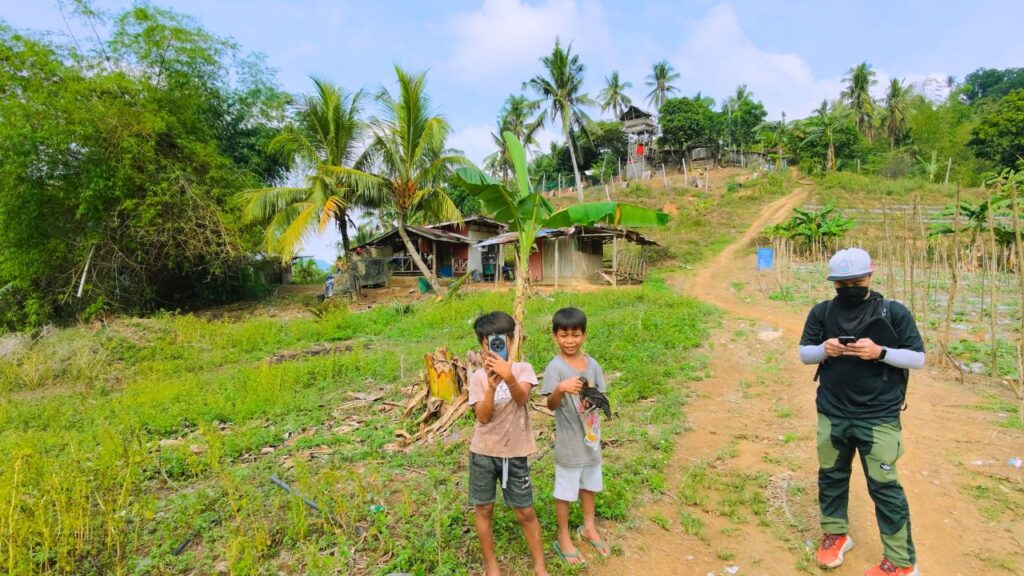
Many hiking trails in Cebu pass through places where people live and work rather than through isolated forest.
Along these community routes, it is common to see farmers tending crops, residents walking between sitios, children traveling to and from school, or families going about their daily routines. While these moments rarely appear in hiking photos or trail summaries, they are a familiar part of walking many of Cebu’s mountain paths.
Unlike trails used mainly for recreation, these footpaths continue to serve the communities around them every day.
Conversations That Happen Naturally
Walking alone through quieter mountain communities often attracts curiosity.
A greeting along the trail can easily become a short conversation about the surrounding area, the condition of the path, or everyday life in the community. These conversations are not planned interviews, nor are they intended to become the focus of a trail report. They simply happen while passing through places that people call home.
Occasionally, they also provide context that is difficult to find elsewhere.
During one field visit, a resident pointed out that a newly constructed concrete footpath had replaced part of an older walking route, explaining why an earlier GPX track no longer reflected the path most people used. On another hike, a resident shared details about a recent accident along the trail, offering local context that would not have appeared on maps or satellite imagery.
Even when these conversations provide useful background, the trail reports continue to rely primarily on observations made during the field visit itself.
More Than Recreational Routes
These encounters highlight that many community trails serve purposes beyond hiking.
The same paths used by hikers may also connect farms, homes, neighboring sitios, schools, and small roadside stores. For local residents, they are part of everyday life long before they become part of a hiking route.
Passing through these communities is therefore different from walking through an uninhabited landscape. A brief conversation, a returned greeting, or a few minutes spent talking beside the trail reflects that these routes remain active parts of living communities rather than empty corridors between destinations.
Not Every Community Trail Is the Same
Some field visits involve several conversations, while others pass quietly with little more than a wave. The experience naturally varies between communities, the time of day, and who happens to be along the trail.
These examples reflect recurring encounters across multiple community routes in Cebu rather than suggesting that every trail or every visit will unfold in the same way.